More golden hair monkeys move downhill amid better protection

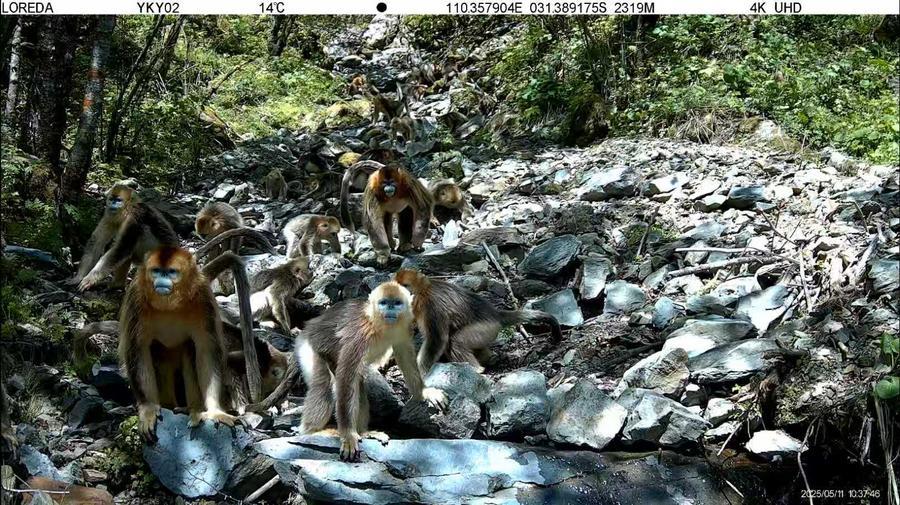
WUHAN, Dec. 17 (Xinhua) -- On a routine winter patrol along a narrow forest trail in a nature reserve in central China's Hubei Province, volunteer ranger Wu Yihong was stopped in his tracks by a flicker of gold and a soft rustle in the branches.
Looking up, Wu spotted a troop of nearly 200 golden snub-nosed monkeys leaping through snow-dusted trees at an altitude of around 1,300 meters. Their unique blue faces and golden fur flashed between the trunks, sending thin layers of snow drifting into the air.
"I know every ridge and valley here, but seeing such a large group of golden snub-nosed monkeys at this altitude is a first," said Wu, 63, who has patrolled the mountains in Badong Golden Monkey National Nature Reserve for more than 20 years. "In the past, one had to climb above 2,000 meters to find them in big groups. But in recent years, they've been coming down more frequently. I even spotted a few at 800 meters."
The golden snub-nosed monkey, also known as the Sichuan golden hair monkey, is under top-level protection in China and is listed as an "endangered" species by the International Union for Conservation of Nature. They typically inhabit high-altitude forests between 1,500 and 3,300 meters.
"It is natural for the monkeys to migrate downhill in winter when snow covers high-altitude regions and food becomes scarce," said Zhu Zhaoquan, vice president of the Hubei Wildlife Conservation Association.
"However, their recent descent in large droves signals a more profound ecological shift," Zhu added.
EXPANDING HABITATS
This shift is rooted in a concerted effort to reconnect fragmented habitats in the region.
The Badong reserve borders the Shennongjia Forestry District, an area known for deep valleys, misty peaks, and rich biodiversity. Together with the neighboring areas, this region is the world's only habitat for the rare Hubei subspecies of golden snub-nosed monkeys. As the population of this subspecies is historically small and isolated, scientists view it as one of the most vulnerable groups of golden hair monkeys.
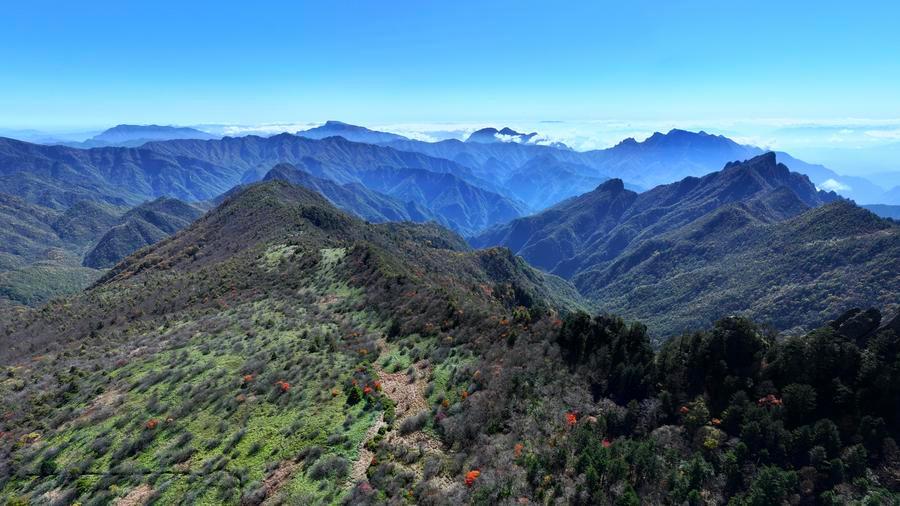
To better protect the monkeys and other wildlife, authorities have spent years reconnecting their habitats, once separated by roads, farmland and administrative borders. In a push for regional integration, Shennongjia, Badong and five other nearby nature reserves formed an alliance in 2018 to coordinate habitat protection and build ecological corridors, allowing wildlife to move freely across administrative boundaries.
"This broke the old pattern where each area fought its own battle," said Qian Caidong, director of the Badong reserve.
Moreover, the expansion of the monkeys' territory has also been aided by the retreat of human activity.
"Many families used to live high up in the mountains, but over the years, they have gradually moved down," said Wang Shixian, former Party chief of Xiaoshennongjia Village, located in the Badong reserve's core area.
As humans stepped back, the forests grew quieter, encouraging the golden snub-nosed monkeys to venture further down the mountains. "They are moving from core zones into buffer areas of the reserve, and from high elevations to mid and low ones," Qian said. "This wider range means more food sources and a lower risk of inbreeding."
Technology is also playing a role. The Badong reserve is equipped with over 400 infrared cameras covering almost the entire reserve, compared to a few dozen five years ago. These cameras have captured the monkeys' behaviors rarely seen before, from the monkeys climbing steep cliffs to turning over creek stones in search of shrimps and crabs.
A 2024 census revealed that the golden snub-nosed monkey population in the Shennongjia region has grown from 501 across five troops in 1990 to 1,618 across 11 troops today. Their habitat has more than doubled in area, expanding from 164 square km to 401 square km.
"The alpha male monkeys look stronger, there are more infants, and the whole population is visibly healthier," Wu observed.
GREEN LIVELIHOODS
The return of the wildlife has not come at the expense of local people. Instead, residents in Xiaoshennongjia and other villages in this region have found new ways to prosper from the greener mountains.
The moist, selenium-rich soil at altitudes between 800 and 1,200 meters in Xiaoshennongjia -- lands no longer intensively farmed -- now produces high-quality wild tea. Every spring, villagers hike into designated picking zones to harvest the fresh leaves.
"Our wild tea has become a hit with consumers," said Wang, noting that since 2019, the tea industry has generated nearly 10 million yuan (about 1.42 million U.S. dollars) in revenue for the village.
Beekeeping is another booming "green industry" in the village, as the diverse flora of the protected forests provides an ideal environment for honeybees. Wang tends to about 70 hives, harvesting honey that brings him an extra 100,000 yuan every year.
"People now see that conservation isn't just about the future; it improves lives today," Qian said, adding that the reserve also provides wildlife accident insurance to compensate farmers for any crop damage caused by animals. ■









Comments